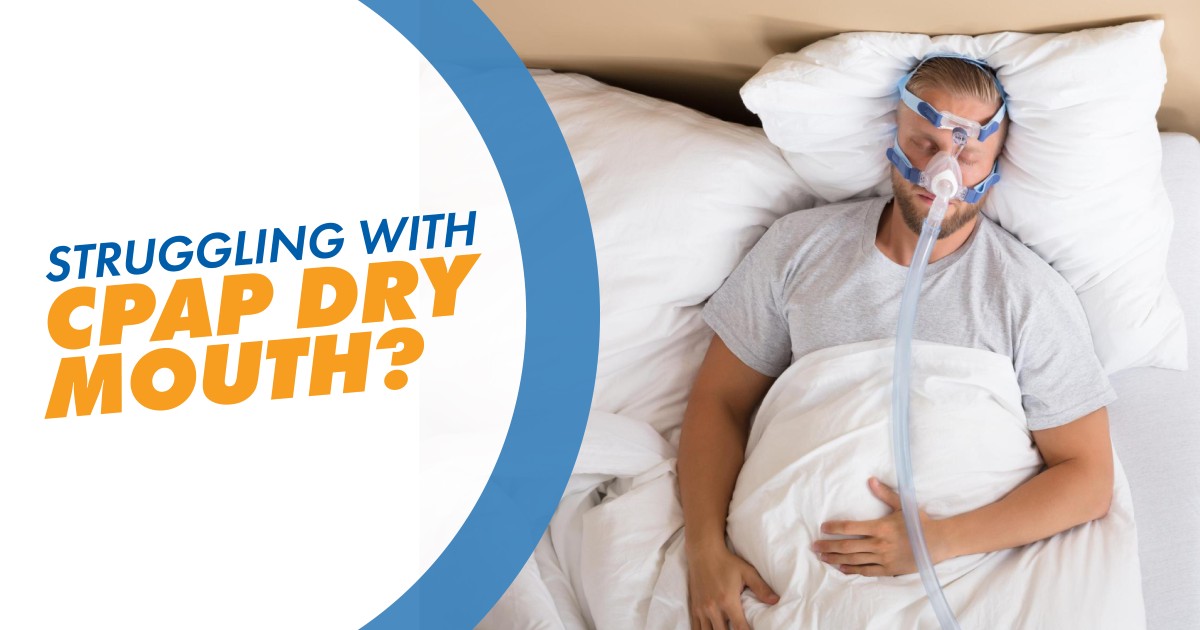
Continuous positive airway pressure (CPAP) therapy is one of the most common treatments for moderate to severe obstructive sleep apnea. The machine delivers a continuous stream of air through a mask, which helps to keep your airway open while you sleep.
However, one common side effect often gets overlooked: CPAP dry mouth.
While it may seem like a minor inconvenience, chronic dry mouth, technically called xerostomia, can increase your risk of cavities, gum disease, bad breath, and other oral health problems if left untreated.
In this post, we’ll explain why dry mouth with CPAP therapy happens, what other dental issues the treatment can cause, and how to protect your smile while treating sleep apnea.
Why Does CPAP Cause Dry Mouth?
A CPAP machine and dry mouth often go hand in hand because the constant flow of pressurized air can evaporate moisture in your mouth.¹
Think of it like holding your hand under a restroom hand dryer for several minutes; the moving air gradually dries the skin. Your CPAP does something similar to your oral tissues, especially if you sleep with your mouth open.
The effect can be even more pronounced if you already have dry mouth because of medications or other health conditions.
Patients sometimes ask about using a nasal mask or a heated humidifier to combat the problem, but you can still experience CPAP dry mouth even with a humidifier or nasal-only mask. It’s hypothesized that this is because the pressure from the machine is higher than the pressure from the salivary glands, which blocks the flow of saliva.²
Why Is Saliva So Important?
The hallmark of dry mouth is not having enough saliva to keep the mouth moisturized. Why does that matter? Well, saliva helps to:
- Wash away bacteria and food debris.
- Neutralize acids produced by plaque.
- Deposit lost minerals back into the enamel, including calcium and phosphate.
- Keep oral tissues lubricated and comfortable.
- Support good digestion.
When saliva production decreases, your mouth loses many of its natural defenses.
Can CPAP Cause Cavities?
Your CPAP machine itself doesn’t cause cavities, but it can indirectly contribute to them.
When you have dry mouth with CPAP therapy, it creates an environment where tooth decay is more likely to occur.
This is because without enough saliva, plaque bacteria multiply more quickly, and food debris and acids stay on the teeth longer. This leaves the enamel vulnerable and can cause cavities to develop faster.
We’ve had patients tell us, “CPAP ruined my teeth.” But the real culprit is actually the chronic dry mouth associated with CPAP use.
CPAP and Oral Health: Other Problems to Watch For
Prolonged CPAP use, as well as the dry mouth it can cause, may contribute to several issues, including:
Increased Risk of Gum Disease
Reduced saliva allows bacteria to adhere to the tooth surfaces and around the gumline. Chronic dry mouth may also cause inflammation and changes in the oral microbiome. These are some of the reasons it’s been tied to an increased risk of gingivitis and periodontitis (gum disease).³
Tooth Sensitivity and Bad Breath
A dry mouth is a common cause of persistent bad breath, and it can make sensitive teeth feel even more uncomfortable.
Mouth Sores and Irritation
Dry oral tissues are more susceptible to irritation, cracking, and sores.
Bite Changes
Although uncommon, studies have shown that long-term CPAP use may contribute to subtle tooth movement and changes in your bite, particularly in patients using certain mask types.⁴
Sleep Apnea and Oral Health: A Catch-22
While the link between using a CPAP and oral health concerns like dry mouth deserves attention, it’s important to remember that untreated obstructive sleep apnea can also take a toll on your smile.
Sleep apnea has been tied to:
Teeth grinding (sleep-related bruxism): Sleep apnea and teeth grinding are common comorbidities. Researchers believe some people clench or grind their teeth as their body attempts to reopen a partially blocked airway during sleep.⁵ Over time, this can lead to worn enamel, chipped teeth, jaw pain, and morning headaches.
Dry mouth: Even without CPAP, people with sleep apnea often breathe through their mouths during sleep. This reduces saliva production and increases the risk of tooth decay and gum disease.
Gum disease: Studies suggest obstructive sleep apnea may be associated with a higher risk of periodontal disease, likely due to chronic inflammation, changes in the oral microbial balance, and reduced oxygen levels.⁶
Jaw pain and TMJ disorders: Nighttime clenching and grinding can place excessive stress on the jaw joints and surrounding muscles.
Systemic health problems: There is significant research to suggest that obstructive sleep apnea is associated with cardiovascular disease, type 2 diabetes, insulin resistance, cognitive impairment, nonalcoholic fatty liver disease, kidney disease, and more.⁷
Treating sleep apnea is critical to health and quality of life. Fortunately, with the right plan and regular dental care, you can enjoy the benefits of effective sleep apnea treatment while minimizing dental side effects.
How to Protect Your Teeth From CPAP
Here are several ways to reduce dry mouth from CPAP therapy and safeguard your oral health.
Stay Well Hydrated
Drink plenty of water throughout the day and keep water nearby at night if needed.
Optimize Your CPAP Equipment
If you’re experiencing CPAP dry mouth even with a humidifier, talk to your sleep physician about:
- Increasing humidifier settings
- Checking for mask leaks
- Trying a different style of mask
- Adding a chin strap if appropriate
Sometimes a small equipment adjustment can make a big difference.
Practice Excellent Oral Hygiene
Because dry mouth increases cavity risk, it’s especially important to brush twice a day with fluoride toothpaste, floss daily, and limit sugary snacks and beverages. You should also keep up with your routine dental exams and cleanings.
Your dentist may recommend extra protection in the form of prescription toothpaste or a professional fluoride treatment.
Consider Saliva Products
Over-the-counter saliva substitutes, moisturizing rinses, or dry mouth gels could help keep your mouth more comfortable overnight.
What If CPAP Isn’t Working for You?
If you simply cannot tolerate a CPAP machine, oral appliance therapy could be an effective alternative.
Joint guidelines from the American Academy of Sleep Medicine and the American Academy of Dental Sleep Medicine recommend oral appliance therapy for select patients with mild to moderate obstructive sleep apnea or those who are unable to use CPAP successfully.⁸
At Naperville Dental Specialists, sleep apnea treatment is led by Dr. Nicolette Michelson-Spencer, who completed a mastery fellowship in oral sleep apnea through the American Academy of Dental Sleep Medicine.
As a sleep apnea dentist, she works collaboratively with sleep physicians to provide oral appliance therapy for patients who have been diagnosed with obstructive sleep apnea.
Unlike over-the-counter snoring devices, these FDA-cleared appliances are custom-made to gently reposition the lower jaw during sleep, which helps to keep the airway open.
Oral sleep apnea appliances are comfortable, don’t make noise like a CPAP machine, and are easy to travel with.
When Should You See Your Dentist?
If you’re using a CPAP machine and notice any of the following, it’s worth scheduling a dental evaluation:
- Persistent dry mouth
- Frequent cavities
- Bleeding gums
- Bad breath
- Tooth sensitivity
- Changes in your bite
- Jaw pain or teeth grinding
Dentists play an important role in monitoring your CPAP and oral health. While many of these changes develop gradually, they can often be managed before they become more serious.
The Bottom Line
CPAP therapy remains one of the most effective treatments for obstructive sleep apnea, but persistent dry mouth shouldn’t be ignored. If left untreated, it can increase your risk of cavities, gum disease, bad breath, and other oral health problems.
Whether you need help managing CPAP dry mouth or you’re wondering if oral appliance therapy may be right for you, the team at Naperville Dental Specialists can help.
Schedule a visit with Dr. Spencer today for personalized, evidence-based care designed to protect your smile, health, and sleep quality.
Sources:
- Tindall, K., Brennan M., Hartz, J., & Harbison, L. (2026). Oxygen at night, consequences by day: Oral health effects of CPAP therapy. RDH Magazine.
- Bortolotti M. (2017). The cause of dry mouth during CPAP application. Journal of Clinical Sleep Medicine: Official Publication of the American Academy of Sleep Medicine, 13(4), 647. https://doi.org/10.5664/jcsm.6568
- Tangsumroengvong, P., Pimolbutr, K., Nopparattanakant, N., Lowpradit, P., & Tansriratanawong, K. (2026). The association between dry mouth and the periodontal status in older adults undergoing supportive periodontal therapy. European Journal of Dentistry, 20(1), 226–235. https://doi.org/10.1055/s-0045-1809183
- Pliska, B. T., & Almeida, F. R. (2018). Tooth movement associated with CPAP therapy. Journal of Clinical Sleep Medicine: Official Publication of the American Academy of Sleep Medicine, 14(4), 701–702. https://doi.org/10.5664/jcsm.7080
- Suni, E. (2025). The link between sleep apnea and teeth grinding. Sleep Foundation.
- Maniaci, A., Lavalle, S., Anzalone, R., Lo Giudice, A., Cocuzza, S., Parisi, F. M., Torrisi, F., Iannella, G., Sireci, F., Fadda, G., Lentini, M., Masiello, E., & La Via, L. (2024). Oral health implications of obstructive sleep apnea: A literature review. Biomedicines, 12(7), 1382. https://doi.org/10.3390/biomedicines12071382
- Henning, R. J., & Anderson, W. M. (2025). Sleep apnea is a common and dangerous cardiovascular risk factor. Current Problems in Cardiology, 50(1), 102838. https://doi.org/10.1016/j.cpcardiol.2024.102838
- Ramar, K., Dort, L., & Katz, S., et al. (2015). Clinical practice guideline for the treatment of obstructive sleep apnea and snoring with oral appliance therapy: An update for 2015. Journal of Clinical Sleep Medicine, 11(7), 773–827. doi:10.5664/jcsm.4858